
*Sponsored post: Vitant®*
Acne at fourteen, thirty-two and fifty-two may share a name, but its drivers, skin environment and treatment needs can be very different. From teenage comedones to hormonal breakouts and menopausal acne, Dr Joan van Wyngaard discusses how Vitant® approaches each life stage with ingredients selected for the biology involved. Central to the approach is an emerging target in recurrent acne: the C. acnes biofilm.
For sixty years, topical acne treatment has been built on a single idea: kill the bacteria. Benzoyl peroxide oxidises it. Antibiotics inhibit its protein synthesis. Salicylic acid opens the follicle so the killing agent can get in.
It works — for a while. Then the lesions come back, often in the same three or four places, and the patient concludes that their skin is simply “like that.”
The microbiology tells a different story. Cutibacterium acnes is not a free-floating organism sitting in an open pore waiting to be killed. Inside the pilosebaceous unit, it builds a biofilm — a structured community of bacteria wrapped in a self-produced matrix of polysaccharide, protein and extracellular DNA. Within that matrix, the same organism becomes dramatically harder to reach, harder to kill and far more persistent. It is the best explanation we have for why acne recurs in the same anatomical sites, and why an agent that clears a lesion does not prevent the next one.
Which raises a more interesting question: what if you targeted the biofilm rather than the bacterium?
A plant from the Eastern Cape
Plectranthus aliciae is a South African member of the mint family. Research conducted at the University of Pretoria — now patented and licensed to Blyde Botanics as the active ACTIFY® — set out to profile its extract against C. acnes in a way most botanical actives are never tested.
The direct antibacterial result was respectable but not remarkable. Against C. acnes ATCC 6919, ACTIFY® showed a minimum inhibitory concentration of 7.80 µg/mL; tetracycline, under the same conditions, came in at 0.78 µg/mL. On the conventional measure, the antibiotic wins comfortably.
The picture inverts when you measure biofilm.
Against C. acnes biofilm formation, ACTIFY® achieved an inhibitory concentration of 3.20 µg/mL against tetracycline’s 0.90. Expressed as a Selectivity Index — activity against biofilm relative to activity against free-floating bacteria — ACTIFY® scores 2.4 where tetracycline scores 0.9. The antibiotic is better at killing bacteria. The plant extract is better at stopping them from building the structure that makes them untreatable.
Four ways to dismantle a biofilm
What makes this dataset unusual is that it does not stop at “inhibits biofilm.” It identifies four separate points of interference — and that breadth is the differentiator, because bacteria adapt around single-target agents.
It interrupts bacterial conversation. Bacteria coordinate biofilm construction through quorum sensing, chemical signalling that tells a population when it is dense enough to build. Autoinducer-2 is a central molecule in that network. At half its MIC, ACTIFY® inhibited AI-2 signalling by 82.8%. Tetracycline, under identical conditions, managed 0.60% — indistinguishable from nothing.
It targets the scaffolding. Extracellular DNA is a structural girder of the biofilm matrix, holding bacteria to the follicle wall and to each other. ACTIFY® inhibited C. acnes eDNA production by 93.8%.
It switches off the enzyme that makes sebum inflammatory. Sebum itself is not the irritant. C. acnes lipase cleaves sebum triglycerides into free fatty acids, and those free fatty acids drive follicular inflammation. In a multispecies biofilm model, ACTIFY® inhibited lipase activity by 99% at half its MIC. Tetracycline showed no measurable lipase inhibition at all.
It works on established biofilms, not just new ones. Preventing biofilm formation in a clean culture is one thing; penetrating a mature one is another. Tested in an artificial sebum model built to mimic the pilosebaceous unit and grow resilient mature C. acnes biofilms, ACTIFY® achieved 83.3% inhibition within those mature biofilms and a further 28.3% reduction in the metabolic activity of the cells that survived.
The part that matters after the spot has gone
Practitioners know the lesion is often the easier half. What patients actually come in about is what the lesion left behind.
Matrix Metalloproteinase-9 is the enzyme responsible for much of the collagen degradation that turns an inflamed lesion into an atrophic scar. ACTIFY® inhibited 96% of MMP-9 activity at 0.41 µg/mL. Tyrosinase is the rate-limiting enzyme in melanin synthesis, and post-inflammatory hyperpigmentation is the dominant post-acne complaint in Fitzpatrick IV–VI skin — which is most of our patient population. ACTIFY® inhibited tyrosinase with an IC₅₀ of 26.3 µg/mL.
Add antioxidant activity — 50% DPPH radical scavenging at 4.80 µg/mL, against vitamin C’s 9.00 in the same assay — and 19.3% promotion of keratinocyte migration in a scratch-wound assay, and you have one active addressing the bacterium, the inflammation, the scar and the mark.
Safety is equally well documented: no significant cytotoxicity in keratinocytes or melanocytes above 100 µg/mL, no mutagenic activity in the Ames assay, and human irritancy scores of 0.38 neat and 0.47 formulated against 2.01 for the sodium lauryl sulphate control.
And it has been on faces. In a 28-day study, 24 volunteers aged 19 to 39 applying an ACTIFY® formulation twice daily showed visible improvement by Day 14, maintained to Day 28, in comedones, blackheads, whiteheads, microcysts and pustules.
The Vitant Clear Wish anti-blemish serum carries ACTIFY® at 5% — the supplier’s full recommended use level, which means the entire dataset above was generated at the concentration in the bottle.
The second active: feeding the microbiome instead of stripping it
Killing bacteria is a blunt instrument, because the follicle is not sterile and should not be. Staphylococcus epidermidis is a beneficial resident that actively competes with C. acnes. Every acne routine that scorches the skin also removes the organisms holding the balance.
So Clear Wish pairs ACTIFY® with ALGAKTIV® BioSKN at 1%, a Chlorella vulgaris extract that is a prebiotic rather than an antimicrobial.
In laboratory work, BioSKN supports S. epidermidis growth while limiting C. acnes, Malassezia furfur and S. aureus. It raises keratinocyte CXCL10 secretion to 207% of basal — CXCL10 being the chemokine that activates the skin’s own antimicrobial response. And when keratinocytes were deliberately driven into an inflammatory state, pushing IL-6 secretion to 274% of basal, 1% BioSKN brought it back to 106%. Essentially baseline.
It was then measured on exactly the patient in question. A double-blind, split-face study in 10 volunteers aged 18 to 30 with oily, acne-prone skin, applying 1% BioSKN or placebo twice daily for 28 days, recorded 9% less sebum and 16% fewer imperfections than the placebo side, with photographic evidence of reduced redness and fewer comedones by Day 14.
ACTIFY® dismantles the biofilm and calms the lesion. BioSKN restores the ecology so the follicle is less hospitable next time.
The retinoid that reduces comedones
Most acne conversations treat retinoids as a wrinkle intervention that patients with acne must simply tolerate. The data on RetinART™ — ALGAKTIV®’s marine bio-retinoid from Chlorella vulgaris — makes the opposite case, and it is the reason RetinART™ appears in the adult acne protocol rather than only in the anti-ageing one.
RetinART™ is selective for the RAR-β receptor isoform, found principally in the dermis, as distinct from RAR-α and RAR-γ, the epidermal isoforms associated with retinoid stinging, flaking and peeling. It is also photostable, with no photosensitivity risk, which is why it can sit inside a morning SPF.
Its comparative study was run specifically in acne-prone skin: 30 women aged 18 to 40 with oily skin, up to 25 comedones and uneven complexion from mild erythema, applying 1% RetinART™ to one half-face and 1% bakuchiol to the other, twice daily for 28 days.
| Endpoint (instrument) | RetinART™ 1% | Bakuchiol 1% |
| Sebum content (Sebumeter®) | −32.9% | −27.4% |
| Pore diameter (3D PRIMOS) | −9.2% | −7.6% |
| Comedone count (mean) | 9.3 → 7.4 | 10.0 → 8.0 |
| Skin redness improved (% of subjects) | 84% | 68% |
| Skin moisturisation (Corneometer®) | +20.7% | +18.2% |
| Comedogenicity classification | Non-comedogenic | Non-comedogenic |
Sebum was the endpoint on which RetinART™ was statistically superior to bakuchiol, at both Day 14 and Day 28. And the comedone result is the one worth pausing on: a retinoid that reduced comedone count by roughly a fifth over 28 days and was formally classified non-comedogenic.
For an adult with breakouts and early lines at the same time, that combination — sebum control, pore refinement, comedone reduction, redness improvement and anti-ageing performance, all from one photostable active safe for morning use — is why the adult protocol is built around the core range rather than around a separate acne line.
Two more actives worth knowing
LactoSporin®, the postbiotic in the Foaming Wash, has the strongest comparative data in the range. In a randomised clinical study in which 64 subjects completed 21 days, LactoSporin® 2% cream was compared head-to-head with benzoyl peroxide. Pustules fell 83.02% on LactoSporin® against 50% on benzoyl peroxide. Open comedones fell 63.11% against 50%, reaching significance by Day 7 rather than Day 14. Papules fell 69.96% against benzoyl peroxide’s 73.86%. Sebum secretion fell significantly on both, and significantly more on LactoSporin®. The authors concluded it was equivalent to benzoyl peroxide on lesions and better than benzoyl peroxide on sebum — without the bleaching, the peeling or the stripped barrier. It also inhibits 5-alpha-reductase, the enzyme converting testosterone to dihydrotestosterone, which is the mechanistic bridge to androgen-driven sebum.
SkinPerf™ LWG, the exfoliating system in the Smoothing Gel, breaks the trade-off that governs conventional acne exfoliation. More acid means more exfoliation, and more exfoliation means more inflammation — a poor bargain in a disease of inflammation, and a worse one in pigmented skin, where the inflammation you create becomes the mark you spend six months treating.
SkinPerf™ holds 15% glycolic, 7% lactic and 6% citric acid on a lamellar biomaterial that behaves as an intra-cutaneous reservoir, releasing roughly twice as slowly as a conventional system. At 2% in the formula, it delivers just 0.56% total AHA — and on human skin explants it produced +50% desquamation against +59% for an 8% free-acid cream and +75% for a 15% one. Near-equivalent exfoliation at a fraction of the acid load.
The inflammation figures are where it becomes interesting. COX-2 quantification recorded 15% inflammation for SkinPerf™ with epidermal cohesion intact, against 68% and 82% for the two free-acid creams, both with damaged cohesion. Expressed as a Performance Index — exfoliation divided by inflammation — SkinPerf™ scores 3.33 against 0.86 and 0.91. It also leaves the acid mantle alone: after a single application, the free-acid creams depressed skin pH immediately and it was still abnormally low two hours later, while SkinPerf™ did not alter skin pH at all.
In 24 women aged 34 to 64 with sensitive, blemish-scarred skin, twice daily for 28 days: blackheads −43%, pigmentation spots −11%, acne scars −8%. Cumulative irritation scoring peaked at 0.5 on a 0–10 scale.
Three life stages, three protocols
Acne at fourteen, at thirty-two and at fifty-two is the same condition with three completely different drivers, three different tolerances and three different sets of co-existing concerns. The most common clinical error in this category is treating all three with the same regimen.
1 · Teen acne
Puberty — roughly ages 12 to 19 — three products
Early acne is predominantly comedonal, and the skin is barrier-immature. Aggressive actives at this age produce a predictable sequence: irritation, barrier compromise, more inflammation, worse acne, and a teenager who abandons skincare entirely.
The protocol is deliberately minimal.
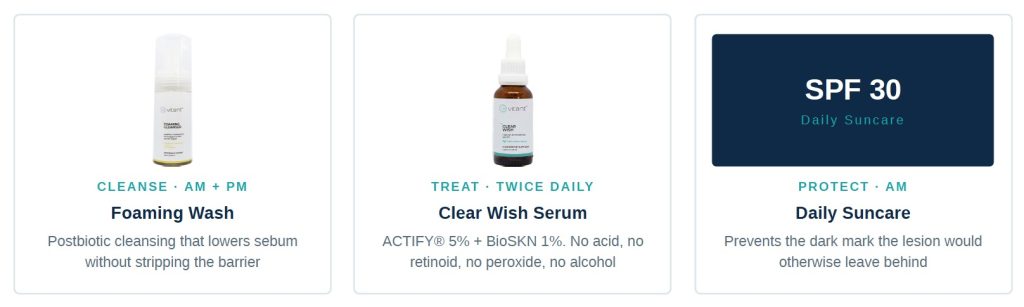
Cleanse — Foaming Wash, morning and evening. Mild glucoside surfactants and the LactoSporin® postbiotic. It reduces sebum without stripping, which is the opposite of what most teenage acne washes do.
Treat — Clear Wish anti-blemish serum, twice daily, morning and night. ACTIFY® at 5% with 1% BioSKN, in a light aqueous serum with niacinamide and Bulbine frutescens. No retinoid, no acid, no benzoyl peroxide, no alcohol. This is the whole treatment step — applied across the affected area rather than dotted onto individual spots, because at this age you are managing a zone, not a lesion.
Protect — Daily Suncare SPF30, every morning. Non-negotiable.
Why sunscreen is a treatment rather than an add-on at this age: every inflamed lesion in pigmented skin risks a post-inflammatory mark, and UV exposure deepens and prolongs it. On a South African playground, a child accumulates enormous UV load. The sunscreen is not protecting a future wrinkle — it is preventing the pigmented scar the child will otherwise still be treating at twenty-five.
Three products. Nothing else. That is two steps at night and three in the morning, and the whole routine takes under a minute. Done consistently for twelve weeks, it outperforms a six-step regime abandoned in three — and the first two come together as the Set to Clear duo for exactly this reason.
2 · Hormonal acne
The childbearing years — roughly ages 20 to 45 — five products
Adult acne is a different problem wearing the same name. It is typically inflammatory rather than comedonal, concentrated along the jawline, chin and neck, cyclical with the menstrual cycle, and driven by androgen-mediated sebaceous activity. It sits on skin that is simultaneously ageing — so the patient is managing breakouts and early lines at once, and cannot afford a protocol that destroys the barrier.
The insight here is that the adult acne patient does not need a separate acne range. She needs the core system, which already contains the actives her acne requires, plus two targeted additions.
Cleanse — Foaming Wash, morning and evening.
Protect and treat, AM — SkinSmart Day Cream SPF30. Three jobs in one morning step: broad-spectrum SPF30, the RetinART™ bio-retinoid, and LactoSporin® microbiome support. This is where the sebum, pore and comedone data above is doing its work, every morning, in the product she was going to apply anyway.
Moisturise, PM — Balancing Moisturiser, carrying RetinART™, niacinamide, LactoSporin® and bakuchiol oil. Lightweight enough for oily and combination skin, and the right texture for a patient who has been told her whole life that moisturiser causes breakouts.
Add: exfoliation — Smoothing Gel, PM only, as a leave-on layer. This clears the follicular congestion driving new lesions and works on the texture and marks left by old ones, at a Performance Index of 3.33 and without touching skin pH.
Add: the spot itself — Clear Wish serum, applied directly to active lesions. This is where ACTIFY® earns its place: on the lesion, on the mature biofilm inside it, and on the mark it is about to leave. Because it also carries tyrosinase and MMP-9 inhibition, it remains the right product on the healing lesion after the inflammation has settled — which is the window in which post-inflammatory pigmentation is decided.
“Clear Wish is my go-to.” Rosanne, our designer, is in her thirties and gets hormonal breakouts along the jawline. Clear Wish is what she reaches for when one appears — used alongside the full system, which is the point. The serum handles the lesion; the system is why there are fewer of them.