
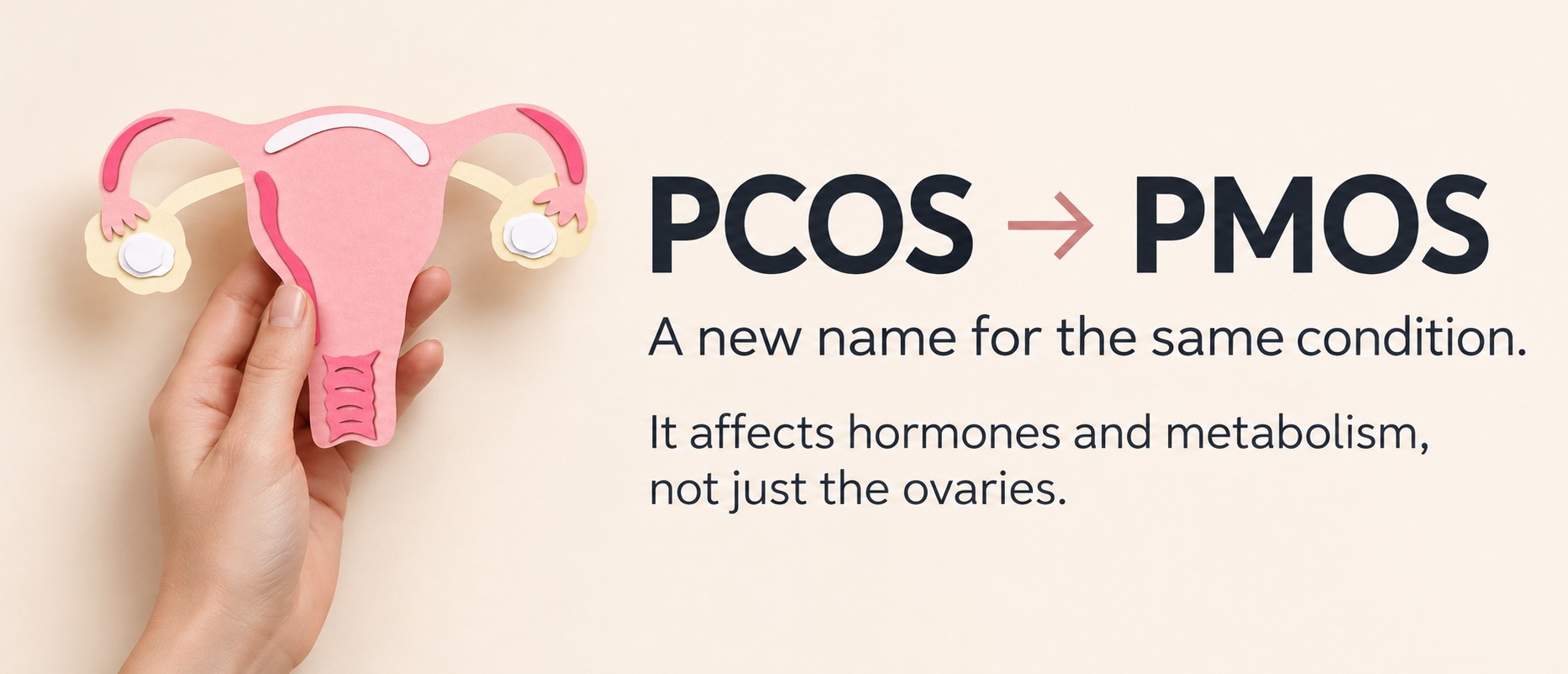
Hormonal conditions can affect far more than reproductive health, with skin and hair changes sometimes offering clues to a wider medical picture. Dr Frances Fleming explains the transition from PCOS (Polycystic ovary syndrome) to PMOS (Polyendocrine Metabolic Ovarian Syndrome) and what it means for diagnosis and care. She also considers how aesthetic practitioners can recognise patterns that warrant medical assessment, while addressing the visible symptoms that affect a woman’s quality of life.
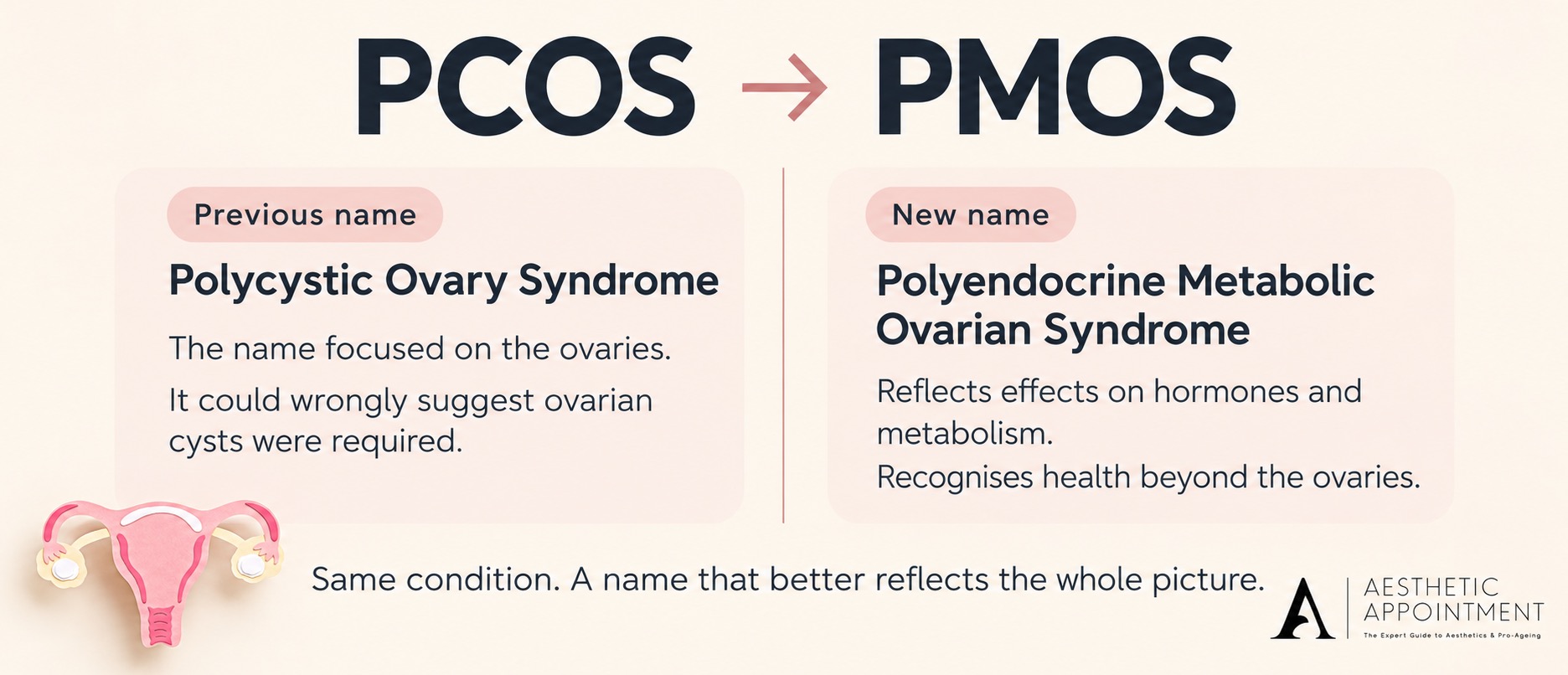
Why the name has changed
For decades, women with irregular periods, unwanted facial hair, persistent acne, difficulty conceiving or problems with weight have been diagnosed with Polycystic Ovary Syndrome—PCOS.
The name has become familiar. Unfortunately, it has also always been rather misleading.
A woman does not need to have polycystic ovaries to have PCOS.
The small follicles responsible for the characteristic ultrasound appearance are not, in the conventional sense, ovarian “cysts”. And, perhaps most importantly, the ovary is only one part of a considerably larger physiological story.
In May 2026, following an extensive international consensus process involving health professionals, researchers and women living with the condition, PCOS was renamed Polyendocrine Metabolic Ovarian Syndrome—PMOS.[1]
The change is far more significant than swapping one acronym for another.
It reflects an important evolution in our understanding of this condition: the ovary matters enormously, but it does not operate in isolation.
PMOS is a heterogeneous, multisystem condition with reproductive, hormonal, metabolic, dermatological and psychological manifestations and health implications extending across a woman’s lifespan.[1–3]
It affects approximately 10–13% of women globally—roughly one woman in eight.
What the skin and hair may reveal
And for those working in the aesthetic field, there is another important reason to understand it-
Some of its most distressing manifestations may be visible on the skin and hair, and the surface may be telling us something deeper.
A woman may not arrive at an aesthetic consultation saying, “I think I have an endocrine disorder.”
She may say:
Why am I still getting acne in my thirties?
Why am I suddenly growing coarse hairs on my chin?
Why is the hair on the top of my head becoming thinner?
Or perhaps:
Why do I keep treating these problems, but they keep coming back?
Hirsutism—excess coarse terminal hair in an androgen-dependent distribution—is an important clinical manifestation of androgen excess. Acne and female-pattern hair loss are also commonly associated with PMOS, although when they occur alone they are substantially weaker predictors of biochemical hyperandrogenism than hirsutism.[2,4]
Acanthosis nigricans—the characteristic velvety, darkened thickening of skin often found around the neck, axillae or other skin folds—may provide a clue to underlying insulin resistance.
None of these findings diagnoses PMOS, however.
Acne is common and multifactorial. Hair loss has numerous causes. Hirsutism has a differential diagnosis too and needs to be investigated. Pigmentation certainly should not automatically be attributed to hormonal disease.
But when several clues occur together—particularly alongside irregular or absent periods, difficulty conceiving, central weight gain or other metabolic features—it is worth asking whether the surface manifestation might be part of a deeper story.
That puts aesthetic practitioners in an interesting and potentially valuable position.
Their role is not to diagnose PMOS from somebody’s appearance. It is to recognise a possible pattern and know when medical assessment may be appropriate.
The ovary is part of a conversation, but by no means the beginning and end of it.
The connection between hormones and metabolism
In general practice, and particularly in my work with women’s hormonal, metabolic and weight-related health, I am repeatedly reminded that symptoms rarely respect the artificial boundaries between medical disciplines.
The reproductive system does not operate independently of metabolism. Metabolism does not exist separately from cardiovascular health, nutrition, body composition, sleep or psychological wellbeing.
PMOS illustrates this beautifully.
Two particularly important biological features are androgen (male hormone) excess and insulin resistance, although their relative importance varies considerably between women.[2,3]
Insulin resistance means that tissues become less responsive to insulin’s actions, requiring greater insulin secretion to maintain metabolic control. The resulting hyperinsulinaemia can also influence reproductive physiology: insulin can augment ovarian androgen production and suppress hepatic production of sex hormone-binding globulin (SHBG), thereby increasing biologically available androgen.
This helps explain why something we think of as “metabolic” can manifest as something apparently “aesthetic”.
The pancreas, liver, adipose tissue, hypothalamic-pituitary-ovarian axis and other physiological systems interact continuously. Genetics and epigenetics, androgen exposure and adiposity-related dysfunction are among the factors implicated in the complex pathophysiology.[2]
However, scientific restraint is important. Research into areas such as the gut microbiome, inflammation and neuroendocrine signalling is fascinating and expanding, but these should not yet be presented as equivalent, established causal pillars of PMOS.
Systems biology does not mean that everything causes everything.
It means recognising that the ovary is participating in a larger endocrine and metabolic network.
Understanding the diagnostic criteria
So how is PMOS actually diagnosed?
Despite the new name, the current evidence-based diagnostic framework remains familiar.
In adults, diagnosis requires two of three features, after excluding other conditions capable of producing a similar clinical picture:
- clinical or biochemical hyperandrogenism;
- ovulatory dysfunction, usually reflected by abnormal menstrual cycles; or
- polycystic ovarian morphology on ultrasound—or, in appropriately selected adults, anti-Müllerian hormone (AMH) used according to the diagnostic algorithm.[2,3]
There are two particularly useful messages here for the public.
First, you can have PMOS without having polycystic ovaries.
Second, simply having polycystic-appearing ovaries does not necessarily mean that you have PMOS.
Indeed, where an adult woman already has both irregular menstrual cycles and clinical or biochemical hyperandrogenism, ovarian ultrasound is not required to establish the diagnosis.[2] AMH should likewise not be used as a stand-alone diagnostic test.
Adolescents require even greater caution. Normal puberty overlaps considerably with features of PMOS, and current international guidance requires both ovulatory dysfunction and hyperandrogenism for diagnosis in adolescents; ultrasound and AMH are not recommended for diagnosis during adolescence.[2,3]
PMOS also remains a diagnosis of exclusion. Depending on the presentation, alternative explanations for ovulatory dysfunction or androgen excess need to be considered, including thyroid dysfunction, hyperprolactinaemia, non-classic congenital adrenal hyperplasia and, where clinically indicated, less common disorders such as Cushing syndrome or androgen-secreting tumours.[3]
This matters enormously.
A label of PMOS should never replace good medicine.
Looking beyond periods and fertility
Perhaps the greatest benefit of moving beyond the old ovary-centred terminology is that it encourages clinicians and patients to consider what happens after the diagnosis.
Historically, many women encountered PCOS primarily because their periods were irregular or because they were having difficulty becoming pregnant.
Those remain important manifestations—but they are only part of the condition.
Women with PMOS have an increased risk of impaired glucose regulation and type 2 diabetes, irrespective of BMI. Current international guidance recommends assessment of glycaemic status at diagnosis and periodic reassessment according to individual risk.[2]
The 75-g oral glucose tolerance test remains the most accurate method of assessing glycaemic status in this population.
Cardiovascular risk deserves attention too. Women with PMOS should have cardiovascular risk factors assessed, including a lipid profile at diagnosis and regular blood-pressure measurement.[2]
Psychological health is equally important. Depression, anxiety, eating disorders, body-image distress and impaired quality of life occur more commonly and should not be treated as peripheral concerns.[2,3]
This broader view changes the conversation in the consulting room.
My concern is no longer simply whether a woman’s ovaries look polycystic or whether her periods are regular. I want to understand her whole health picture: her glucose regulation, lipid profile and blood pressure; her weight trajectory and body composition where relevant; her menstrual and reproductive history; her nutrition, activity and sleep; her skin and hair symptoms; and her psychological wellbeing.
We are not treating an ultrasound appearance. We are treating a woman.
Weight, lifestyle and individualised care
Weight matters—but this is not a disease caused by weight…
This deserves particular emphasis.
PMOS occurs across the weight spectrum.
Higher weight and central adiposity can exacerbate metabolic and reproductive manifestations in some women, and weight management can produce clinically meaningful improvements where it is appropriate. But PMOS must not be reduced to “a disease caused by being overweight”.
The international guideline specifically recognises the considerable weight stigma experienced by women with this condition and recommends respectful, individualised and weight-inclusive care.[2]
Lifestyle intervention remains foundational—not as punishment for having PMOS, but because nutrition, physical activity and other healthy behaviours improve metabolic and general health.
Importantly, there are health benefits from lifestyle intervention even without weight loss.[2]
Nor is there evidence for one magical “PCOS/PMOS diet”. Current evidence does not establish one particular dietary composition as superior for all women. Sustainable healthy eating should instead be individualised to the woman’s metabolic needs, preferences and circumstances.
Treatment according to each woman’s priorities
Can PMOS be treated?
Absolutely—although treatment is not one-size-fits-all.
Management should be directed towards the individual woman’s priorities and phenotype: metabolic health, menstrual regulation, androgen-related symptoms, weight management, fertility, psychological wellbeing or, commonly, several of these simultaneously.[2]
Lifestyle measures—including appropriate nutrition and regular physical activity—form an important foundation for all women.
Metformin has an established role particularly for metabolic indications and should be considered in adults with PMOS and a BMI of 25 kg/m² or above; it can also be considered below this threshold, although the supporting evidence is more limited.[2]
For women troubled by irregular menstrual cycles and/or hirsutism who do not currently wish to conceive, a combined oral contraceptive pill may be appropriate following individual assessment of risks and contraindications. For metabolic indications, the guideline favours metformin over the combined oral contraceptive pill.[2]
For women living with higher weight where pharmacological weight management is clinically indicated, anti-obesity medications—including GLP-1 receptor agonists such as liraglutide and semaglutide or tirzepatide—may be considered according to general population obesity guidelines, alongside active lifestyle intervention. These medicines should not be described as a specific “cure” for PMOS, and pregnancy considerations, adverse effects, long-term treatment and the risk of weight regain after discontinuation need to form part of shared decision-making.[2]
Treating excess hair growth and visible symptoms
For hirsutism, anti-androgen therapy can be considered in selected women when response to combined oral contraception and/or cosmetic treatment has been inadequate, with effective contraception where pregnancy is possible because of potential fetal effects.[2]
And importantly for the aesthetic profession, laser and light-based hair reduction are themselves recognised evidence-based treatments for facial hirsutism. Women with PMOS may require more treatment sessions than women with idiopathic hirsutism, and treatment should be provided by appropriately experienced practitioners.
The visible symptom deserves treatment too.
There is no virtue in telling a woman distressed by facial hair that we are “treating the underlying cause” while ignoring the symptom affecting her every time she looks in the mirror.
Often the best care is both systemic and local.
Fertility and pregnancy
And what about fertility?
PMOS is an important cause of anovulatory infertility, but women should be reassured that pregnancy can frequently be achieved naturally or with assistance.[2]
When anovulation due to PMOS is the cause of infertility, and there are no other infertility factors, letrozole is currently recommended as first-line pharmacological ovulation induction.[2]
Again, the treatment depends upon the woman in front of us.
A 22-year-old distressed by hirsutism, a 32-year-old trying to conceive and a 42-year-old with impaired glucose tolerance and increasing central adiposity may share the same diagnosis but require very different clinical priorities.
That heterogeneity is part of PMOS.
A message for aesthetic practitioners
For those working in aesthetics, perhaps the most useful contribution is not another treatment protocol but a heightened awareness of patterns.
Persistent or severe hirsutism—particularly when accompanied by irregular periods—is a strong reason to consider medical assessment. Persistent acne or female-pattern hair loss may contribute to the picture, although individually they are much less specific for hyperandrogenism.[2,3]
Good multidisciplinary care should address both health and quality of life.
When to discuss symptoms with your doctor
There is an important caution for women reading this article.
Having acne does not mean you have PMOS.
Neither does gaining weight, losing hair, having pigmentation or occasionally having an irregular period.
All of these are common and have numerous possible causes.
But if you recognise several features occurring together—particularly irregular or absent periods together with increased facial or body hair, persistent acne, scalp hair thinning, difficulty conceiving or metabolic problems—it is reasonable to discuss the pattern with your doctor.
The purpose of greater awareness is not to encourage self-diagnosis.
It is to encourage better diagnosis.
Looking at the whole woman
The transition from PCOS to Polyendocrine Metabolic Ovarian Syndrome represents more than a change in terminology.
It changes the lens.
The ovary remains important. But it is no longer asked to carry the entire explanation for a complex, heterogeneous condition involving reproductive function, androgen biology, metabolism and long-term health.
For me, that is the most valuable part of the change.
In general practice, women rarely arrive neatly divided into specialities. The woman concerned about her facial hair may also be worried about her fertility. The woman struggling with weight may also have irregular periods. The patient asking about adult acne may have a family history of diabetes that nobody has yet connected to the rest of her story.
And an aesthetic practitioner may sometimes be the first health professional to see one piece of that pattern.
The skin and hair do not diagnose PMOS. But sometimes they provide the first visible clue that there is more to investigate beneath the surface.
The lasting advance of PMOS will therefore not simply be that medicine has found a better acronym.
It will be that we have learned to look beyond the cyst, beyond the ovary and beyond the isolated symptom—to the whole woman.
References
- Teede HJ, et al. Polyendocrine metabolic ovarian syndrome, the new name for polycystic ovary syndrome. The Lancet. 2026. This international consensus paper establishes PMOS as the new terminology for PCOS and reports a global prevalence of approximately one in eight women. The Lancet — PMOS renaming paper. The Lancet
- Teede HJ, Tay CT, Laven J, Dokras A, Moran LJ, Piltonen TT, Costello MF, Boivin J, Redman LM, Boyle JA, Norman RJ, Mousa A, Joham AE, et al.; International PCOS Network. Recommendations from the 2023 International Evidence-based Guideline for the Assessment and Management of Polycystic Ovary Syndrome. Human Reproduction. 2023;38(9):1655–1679. This is the principal international evidence-based guideline underpinning the diagnostic and therapeutic recommendations discussed in this article. 2023 International Evidence-based Guideline — Human Reproduction
- Joham AE, et al. Diagnostic Challenges in the Workup for Polycystic Ovary Syndrome. Journal of Clinical Endocrinology & Metabolism. 2025;110(7) et seq. Contemporary review of the heterogeneous multisystem presentation, diagnostic criteria, differential diagnosis, hyperandrogenism and metabolic manifestations of PCOS/PMOS.
- Farhan M, et al. A narrative review on cutaneous manifestations in polycystic ovary syndrome. 2025. Reviews the dermatological manifestations associated with the syndrome, including hirsutism, acne and alopecia, and their management.
NOTE: Because PMOS was only formally introduced in May 2026, much of the evidence base cited above necessarily uses the historical term PCOS. The underlying condition has not suddenly changed; only the nomenclature has. The 2023 international guideline therefore remains the major evidence-based clinical guideline while PMOS terminology is introduced into clinical practice and future publications. The official guideline resources have already begun transitioning to PMOS terminology.