

Significant weight loss can bring welcome changes in health and confidence, while also changing facial volume and skin support. Dr Hildegardt Raubenheimer explains why planning aesthetic care around the weight-loss journey matters, particularly while weight and facial contours are still changing. She discusses how individualised treatment can address skin quality, collagen and facial structure as patients move towards a stable weight.
The arrival of GLP-1 receptor agonists has changed the landscape of medical weight management. Medications such as semaglutide and tirzepatide are helping many patients achieve significant improvements in weight and metabolic health.
Alongside these benefits, however, aesthetic practitioners are encountering a new consideration: what happens to the face when substantial weight loss occurs relatively quickly?
Understanding facial changes after weight loss
The popular term “Ozempic face” has become shorthand for this phenomenon. I believe we should use it cautiously. The facial changes seen in these patients are not necessarily a unique adverse effect of one particular medication.
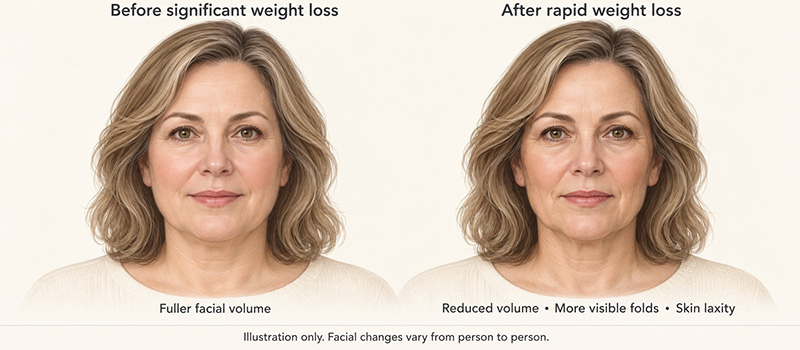
Rather, they largely reflect something we have long understood in aesthetic medicine: significant weight loss changes facial volume, and when it occurs faster than the tissues can adapt, those changes may become particularly noticeable.
For many patients, successful weight loss marks the beginning of an exciting new chapter – greater mobility, improved health, renewed confidence and the joy of feeling at home in a changing body. But transformation does not have to come at the expense of facial vitality.
As GLP-1 therapies continue to reshape the way we approach weight management, aesthetic treatments can greatly benefit maintaining a healthy facial aesthetic alongside weight loss. Rather than waiting for significant volume loss, skin laxity and accelerated signs of ageing to become established, we can think proactively: supporting collagen, preserving skin quality and strategically addressing structural changes as the face adapts to a leaner body.
Why does the face change?
Facial ageing is not simply about wrinkles. It is a complex, three-dimensional process involving skin, fat compartments, retaining ligaments, muscle and bone.
Facial fat provides important structural support. When a patient loses a significant amount of weight, subcutaneous and deeper facial fat may decrease alongside fat elsewhere in the body. The result can be loss of midface projection, hollowing of the temples and cheeks, greater visibility of the tear trough, and increased prominence of nasolabial folds and marionette lines.
The lower face may also appear heavier or more lax, not because tissue has necessarily increased, but because the structures that previously supported the skin have diminished.
The face can therefore paradoxically look older while the patient feels healthier and more confident in their body.
How age and skin elasticity influence the changes
Age is another important consideration. Younger skin generally has greater elasticity and may accommodate changes in facial volume more effectively. As collagen and elastin naturally decline with age, rapid volume loss may reveal or accelerate the appearance of pre-existing laxity.
Matching treatment to the patient’s needs
This is where aesthetic medicine needs to be thoughtful.
A careful assessment should identify which layers have changed and what the patient actually needs.
For one patient, subtle structural restoration with hyaluronic acid filler may be appropriate. For another, improving collagen and tissue quality may be more important than adding volume.
Biostimulatory treatments can play an important role where collagen loss and skin laxity predominate. Energy-based technologies, including radiofrequency and microneedling-based treatments, may be incorporated to improve skin quality and support collagen remodelling. Skin boosters and regenerative approaches may also form part of an individualised plan.
Often, the most natural result comes from combining modalities conservatively rather than relying heavily on a single treatment.
Planning around the weight-loss journey
As an Aesthetic practitioner, I always consider where the patient is in their weight-loss journey.
If weight is still changing rapidly, facial anatomy may continue to evolve. Restoring natural volume and structure during this period and early collagen stimulation may mean that, as the patient continues to lose weight, the aesthetic of the face looks appropriate once the patient’s weight stabilises.
The goal is not to replace every lost millilitre of volume, nor to recreate the face you had before weight loss. It is to protect what makes your face uniquely yours.
With thoughtful planning, treatments such as biostimulation, energy-based devices, skin-quality treatments and carefully considered volume restoration can become part of a longer-term strategy, a treatment plan that respects both the biology of ageing and the holistic transformation taking place.

Celebrating change while still feeling like you
So celebrate the new body. Enjoy the clothes that fit differently, the movement that feels easier and the confidence that comes with achieving something meaningful. And while your body is changing, remember that your skin, collagen and facial structure deserve attention too.
Weight loss may change your silhouette. Thoughtful aesthetic care can help ensure that the face looking back at you still reflects your vitality, your confidence and, most importantly, you.
About the author

Dr Hildegardt Raubenheimer (Dr Hilla) is a GP with a special interest in Aesthetic and Anti-Aging Medicine, with her private practice located in Cape Town. She qualified as a medical doctor from the University of Stellenbosch in 2004. She started her training in Aesthetic Medicine in 2012 when she completed a Certificate of Aesthetic Medicine through the American Academy of Aesthetic Medicine. She completed the Advanced Diploma in Aesthetic Medicine through the Foundation of Professional Development of South Africa and attended extensive training through the Medskills Training Academy. In addition, she has attended Integrative Medicine training through the Golding Institute and continues to upskill herself in the fast-evolving field of Aesthetic Medicine.