
*Sponsored post: Nourkrin® SA*
Hair loss is often approached through hormones, blood flow and the hair growth cycle, but growing research is also focusing on the structural role of proteoglycans within the hair follicle. Dr Cathy Davies explores Proteoglycan Replacement Therapy (PRT®), how the depletion of key follicular proteoglycans may contribute to hair loss, and where this approach may fit alongside established treatments. She also looks at the science behind Nourkrin® with Marilex®-P, which recently launched in South Africa, and its potential role in supporting the follicle from within.
Proteoglycan Replacement Therapy has recently entered my practice as a therapeutic aid for treating hair loss. In medicine, the world of “replacement therapy” is becoming increasingly popular, and for good reason. When we are young and healthy, our cells, hormones and signalling molecules are all optimal. As we age, some of these become sub-optimal. The aim of replacement therapy is to restore optimal physiological levels, not supraphysiological ones (this means levels or doses that are higher than what the body naturally makes or has).
In the case of hair loss, certain proteoglycans around the follicle deteriorate and need to be replaced.
At a glance: Proteoglycan Replacement Therapy
WHAT IT IS: A daily supplement (Nourkrin® with Marilex®-P) delivering bioavailable follicular proteoglycans: versican, decorin and syndecan.
HOW IT WORKS: Reactivates Wnt/β-catenin signalling to trigger anagen re-entry and restores the follicle’s structural matrix.
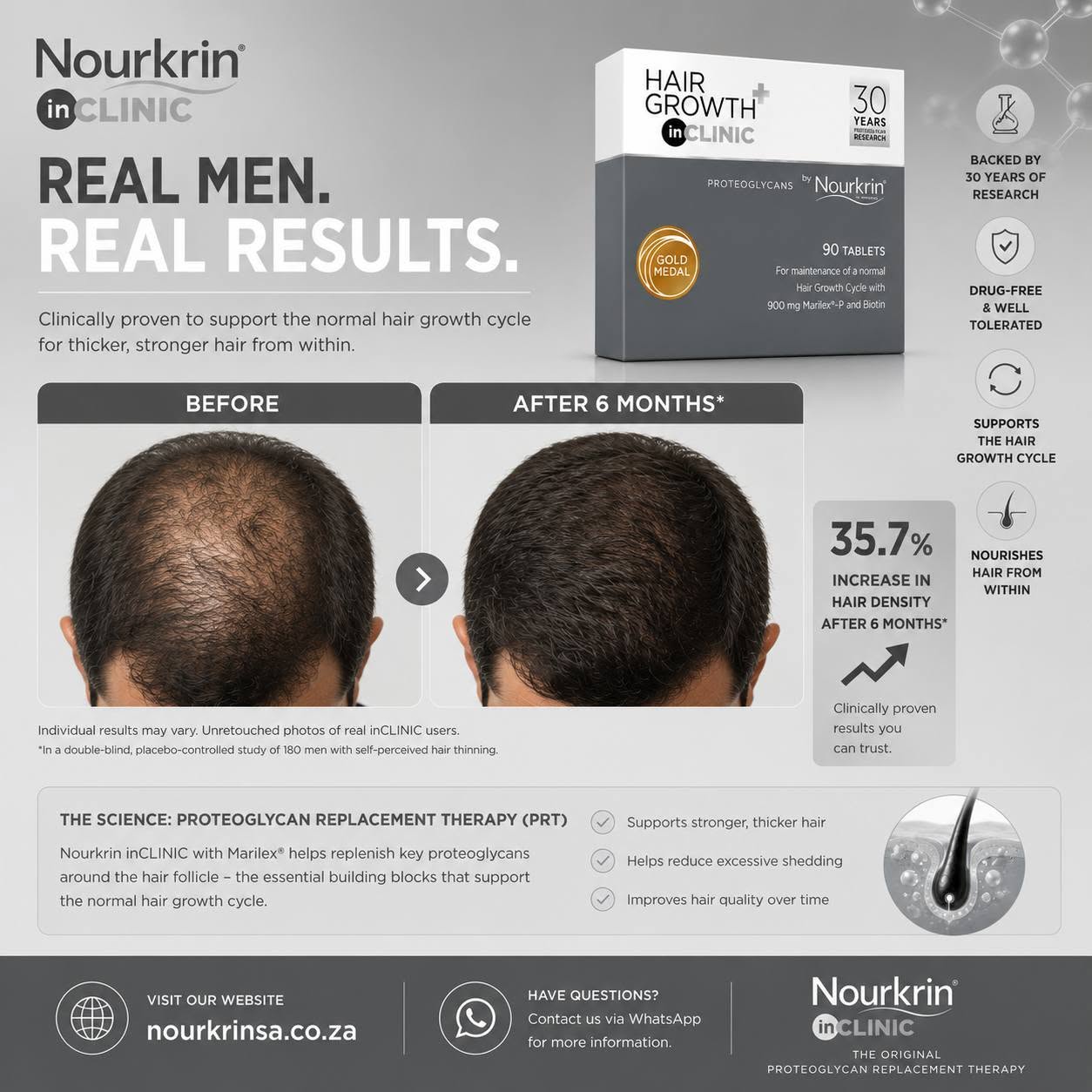
THE EVIDENCE: 45+ years of proteoglycan research; World Hair Council Gold Medal, 2021; hair count improved by up to 35.7% versus placebo in controlled trials.
WHO IT’S FOR: Men and women with pattern hair loss or telogen effluvium; safe for use before and after hair transplant surgery.
THE DOSE: 3 tablets daily (900 mg Marilex®-P) with food. Visible change typically takes 3–6 months.
The follicle’s missing scaffolding
Proteoglycans are not a familiar word to most patients, and until recently, they were not a familiar word to most hair loss clinicians either. Yet these unassuming molecules – protein cores decorated with long sugar chains – form part of the scaffolding that holds every hair follicle together.
Three matter most: versican, which helps keep the follicle in its active, hair-producing anagen phase; decorin, which appears to act as a natural trigger for anagen to begin in the first place; and syndecan, which works as a co-receptor for the growth factors and Wnt signals the follicle depends on to keep dividing.
Strip these away, and the follicle does not simply lose a nutrient. It loses its structural integrity.
Beyond DHT: A new culprit
For decades, the conversation around male and female pattern hair loss began and ended with DHT (dihydrotestosterone) and the follicle’s sensitivity to it. DHT is real, and it matters. But it has never fully explained why some follicles miniaturise while others, sitting side by side on the same DHT-exposed scalp, do not.
Research now points to a second, structural process running in parallel: as follicular proteoglycans are progressively depleted, the follicle enters a state researchers call Follicular Hypo-Glycania, which shortens anagen and lengthens the resting, shedding phases of the cycle.
Left unaddressed, this progresses to Proteoglycan Follicular Atrophy, in which the dermal papilla shrinks, the extracellular matrix breaks down, and the follicle’s capacity to regrow a full terminal hair is lost.
“DHT may pull the trigger. Proteoglycan depletion is the mechanism that lets it.”
Restoring, not blocking
This is where Proteoglycan Replacement Therapy, or PRT, comes in – and it is one of the more elegant treatment concepts I have added to my practice.
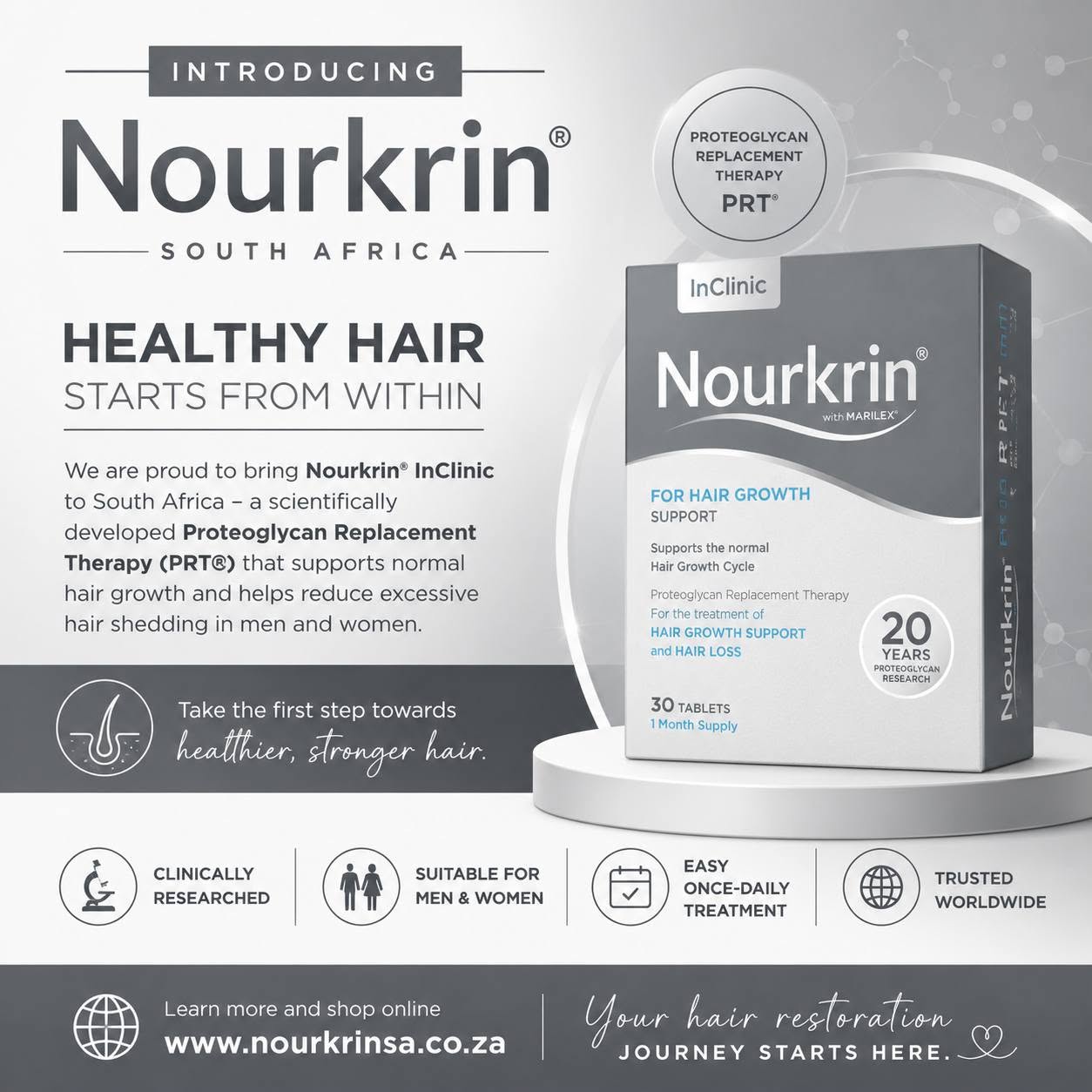
Rather than blocking a hormone or dilating a blood vessel, PRT supplies the follicle with bioavailable versican, decorin and syndecan, sourced through a patented marine cartilage extract called Marilex®-P and delivered in Nourkrin®.
In the follicle, this appears to reactivate Wnt/β-catenin signalling – the pathway that tells a resting follicle to re-enter anagen – while suppressing catagen-inducing mediators such as IL-6 and TGF-β that would otherwise push it back into decline. It restores hydration and fibroblast activity within the follicle’s matrix, interrupting the hypo-glycania-to-atrophy cascade before it reaches the point of no return.
It is worth being precise about what this does and does not replace. Minoxidil and finasteride remain genuinely useful, well-studied treatments, and I continue to prescribe them.
But both act from the outside in: minoxidil by improving blood flow to the follicle, finasteride by lowering the DHT it is exposed to. Neither rebuilds the follicle’s internal structure once proteoglycan depletion has set in.
PRT is the first therapy in my toolkit that works from the inside out, and because it has no hormonal or vascular action, it can be used safely in men and women, and alongside minoxidil or finasteride rather than instead of them.
A different kind of evidence
The clinical pedigree behind this is longer than most patients expect. Nourkrin® with Marilex has more than 45 years of research behind its proteoglycan science, and in 2021 was awarded the Gold Medal by the World Hair Council.
In controlled trials, patients using the therapy have shown hair counts improving by as much as 35.7% relative to placebo, a figure that holds up well against far more aggressive interventions.
“In the past few years we are seeing some new causes of hair loss in practice; GLP-1s, initiation of some hormone therapy and viral infections such as COVID.”
Built into the operating room
One of the more persuasive signs that a treatment concept has scientific legs is when surgeons start building it into their surgical protocols, not just their retail shelves. That is exactly what has happened with PRT.
Hair transplant surgeons are increasingly prescribing it for three months before surgery, to strengthen the native follicles that will surround the new grafts, and for six to twelve months afterwards, to reduce a common and under-discussed complication called shock loss, where the trauma of surgery pushes surrounding follicles into a temporary shedding phase that can take up to two years to resolve, and is frequently, and wrongly, mistaken for graft failure.
Because transplant surgery does nothing to stop the underlying miniaturisation of a patient’s own remaining hair, protecting those native follicles is arguably as important as the transplant itself.
What this looks like in practice
In practice, the protocol is refreshingly simple: three tablets a day, ideally with food, for a minimum of three to six months before any real change becomes visible, since we are working with the natural hair cycle rather than around it.
It is not a dramatic, overnight fix, and I am always careful to say so. But that, in a way, is the point. We are not trying to force the follicle to do something unnatural. We are giving it back what time and biology have quietly taken away, so it can do what it was always designed to do.
That, to me, is the real promise of replacement therapy in any form: not more, but enough. Not supraphysiological, but optimal.
For a growing number of my patients, restoring their follicles’ own proteoglycans is proving to be exactly that.
*Disclaimer: this article was commissioned by Nourkrin® SA; however, the content therein is based on Dr Cathy Davies’ clinical experience*
Find Nourkrin® in South Africa
Nourkrin® is available in South Africa through selected stockists and online.
Want to become a Nourkrin® stockist?
Contact Nourkrin® SA to find out more about stocking the range in your clinic, practice or retail space.
Looking for a stockist?
Contact the Nourkrin® SA team to find your nearest stockist.
Buy online: www.nourkrinsa.co.za/subscriptions
For more information: www.nourkrinsa.co.za
Email: info@nourkrinsa.co.za
Tel: +27 83 289 9825
Follow Nourkrin® SA:

About the author

Medical Practitioner, Johannesburg MBBCh (Wits 1998) MBA (Henley 2007), MSc LonegvitySci
Dr Cathy is a General Practitioner with a special interest in hair transplantation and aesthetic medicine. She is a lead educator for PRF Edu, Venice Florida. Dr Cathy is renowned for her TV show "Outpatients" which aired from 2018 to 2020, helping victims of violent injuries, burn victims and those seeking life changing hair restoration. She is also a published author.