
Disclaimer: This article was commissioned by AQ Skin Solutions Africa. The content reflects Dr Nerina Wilkinson’s professional experience and opinion, including her use of AQ MAPS in clinical practice. Patients should consult their doctor to discuss whether facial fat grafting is appropriate for their individual needs. Healthcare providers seeking further information about AQ MAPS can contact AQ Skin Solutions Africa directly: visit www.aqskinsolutionsafrica.com, email info@aqskinsolutionssa.com or call +27 21 914 1169.
Facial fat grafting uses a patient’s own adipose tissue – body fat – to restore volume in areas of the face that have become hollow or lost fullness, while finer preparations may also be used to help improve skin and tissue quality. Plastic and reconstructive surgeon Dr Nerina Wilkinson explains why fat mapping – assessing where fat is needed and where it should not be added – and careful patient selection are essential to planning treatment. She also shares how she uses AQ Therapeutics MAPS (Micro Adipose Processing System) Kit from AQ Skin Solutions to process the collected fat into different preparations, depending on the area being treated and whether the aim is to restore fullness or improve tissue quality.
For many years, facial fat grafting was described primarily as a method of replacing lost volume. Today, that description feels incomplete. Autologous adipose tissue is not simply a filler; it is living tissue.
Alongside mature adipocytes, fat contains a complex stromal and vascular environment incorporating endothelial and perivascular cells, immune cells, extracellular matrix and adipose-derived stromal cells. Together, these components participate in processes including angiogenesis, tissue repair and extracellular-matrix remodelling. This helps explain why, in appropriately selected patients, fat grafting may influence not only facial contour but also the quality of the tissues into which it is placed.
It is important, however, that we use the term “stem cells” responsibly. Mechanically processed fat is not equivalent to an injection of isolated or cultured stem cells. Rather, it is autologous tissue containing a heterogeneous population of cells, extracellular matrix and biological signals with regenerative potential.
I believe this distinction is important. Regenerative medicine should be driven by anatomy, biology and evidence rather than terminology that promises more than a treatment can reliably deliver.
Fat mapping: treating anatomy, not simply adding volume
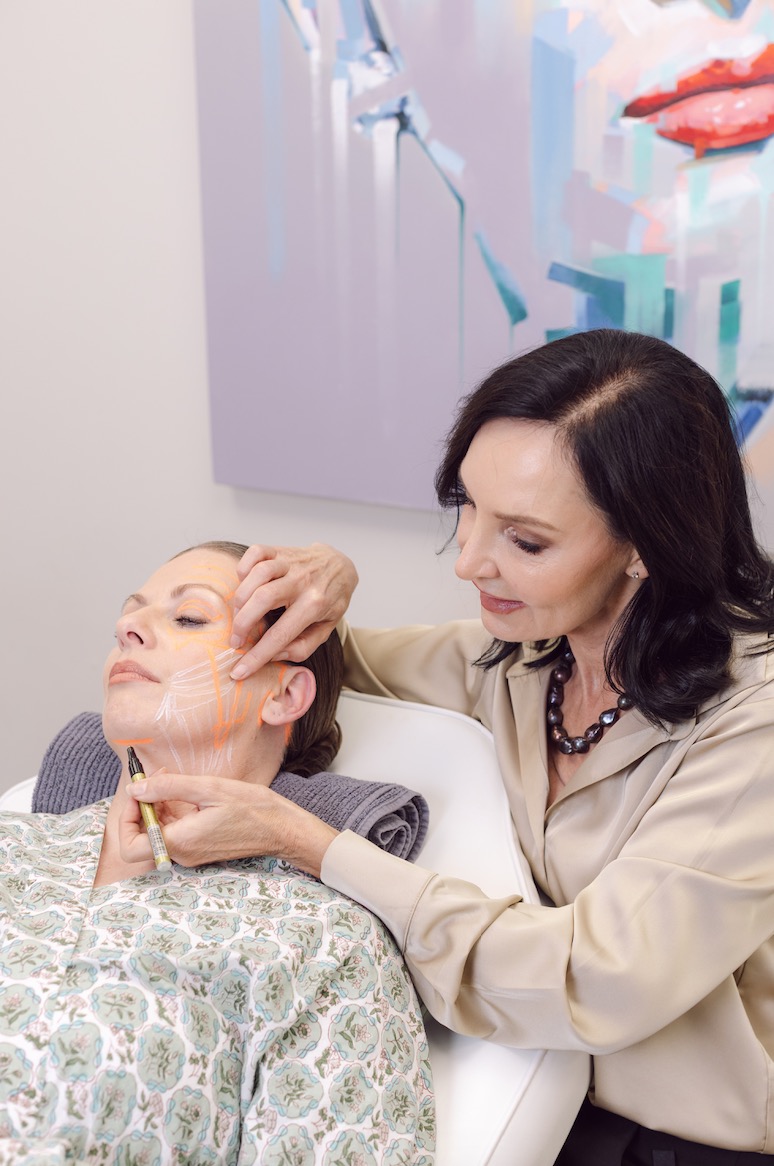
One of the most important advances in our understanding of facial ageing has been the recognition that facial fat exists in distinct superficial and deep anatomical compartments. These compartments do not all age in the same way or at the same rate. At the same time, ageing affects the skin, retaining ligaments, deeper soft tissues and underlying skeleton.
The ageing face therefore cannot simply be viewed as a face that has “lost volume”.
This is where fat mapping becomes fundamental.
Before adding fat, I want to understand why a particular area looks aged. Is there genuine deflation? Has the tissue descended? Is there loss of skeletal support? Is skin quality the primary problem? Or is there sufficient laxity that the patient would benefit more from surgical repositioning?
My approach is not to fill the face indiscriminately, but to identify where volume has genuinely been lost and restore it selectively.
Areas such as the temples, midface and lid-cheek junction may benefit greatly from carefully planned fat replacement in appropriately selected patients. Equally important is recognising where fat should not be added. If jowling, laxity and tissue descent are the dominant problems, additional volume cannot substitute for repositioning the tissues.
Good fat grafting therefore begins with diagnosis, not injection.
Why fat quality matters
Once we regard fat as living tissue rather than simply as volume, the way we handle it becomes particularly important.
A successful fat graft has to survive transplantation and establish vascular support within its new environment. Its behaviour is therefore influenced by the entire journey of the tissue: how it is harvested, how gently it is handled, how it is processed, the size of the fat particles and how precisely it is placed.
For me, the fundamental principle is simple: fat should be treated as living biological tissue, not as an inert injectable product.
Different preparations can also serve different purposes. Larger fat parcels may be useful where structural volume is required, while finer preparations such as microfat allow more delicate placement.
As the particle size becomes smaller and we move towards micro-fragmented fat and nanofat preparations, the therapeutic objective can begin to shift away from volume alone towards tissue quality and regenerative signalling.
Nanofat illustrates this particularly well. Mechanical emulsification disrupts most mature adipocytes, which means nanofat provides very little conventional volumising effect. Its interest lies rather in the stromal, vascular and regenerative components that remain within the processed tissue. Clinically, these preparations have been explored for applications including fine lines, scars, pigmentation and improvement of delicate lower-eyelid skin.
Why fat processing matters
Once fat has been harvested, processing becomes an important bridge between the tissue we have collected and the clinical result we are trying to achieve.
The objective is not simply to prepare fat so that it can pass through a cannula. We want to remove unwanted blood, free oil and debris, while creating a graft with the appropriate purity, consistency and particle size for the anatomical layer and treatment objective.
There are numerous approaches to fat processing, from traditional techniques such as sedimentation, washing and centrifugation to dedicated mechanical processing systems. Commercially available platforms include systems such as Lipocube and AQ MAPS, amongst others. Different technologies use different methods of washing, filtering, sizing and micro-fragmenting adipose tissue, and no single processing platform should be regarded as universally superior for every clinical indication.
For me, the advantage of working with a dedicated processing system is primarily control, consistency and reproducibility.
A graft intended to restore deeper structural volume has very different requirements from a finer graft being placed in a delicate facial transition. Similarly, a micro-fragmented preparation being used primarily with the intention of improving tissue quality requires a different approach from a conventional volumising fat graft.
In my current practice, I use the AQ MAPS system as one of the tools within this process. What I find useful is the ability to prepare different grades of adipose tissue within an organised system, allowing me to match the characteristics of the graft more closely to the anatomical and biological objective of the treatment.
The technology itself, however, is only one part of the equation.
No processing system can compensate for incorrect diagnosis, inappropriate patient selection or poor placement. Ultimately, successful fat grafting still depends upon thoughtful mapping, gentle harvesting, appropriate processing and precise anatomical placement.
Selecting the right patient
Patient selection remains critical.
Fat grafting can be particularly valuable where there is a genuine volume deficit, contour deficiency or anatomical transition that can benefit from autologous tissue. Finer regenerative preparations may also be considered where improving tissue quality or scar characteristics is an important objective.
Patients must also understand that fat is biological. Graft survival varies, some resorption should be anticipated, and occasionally a staged procedure provides the most natural result.
Importantly, regenerative treatments should complement sound surgical principles rather than be used to avoid them. A patient with significant skin excess, advanced jowling or structural descent may require surgery rather than more volume.
The future: regeneration by design
I believe the future of aesthetics will increasingly move away from asking:
“Which treatment should we use?”
and towards asking:
“Which tissue is ageing, and what does that tissue biologically and structurally require?”
Autologous fat is particularly exciting because it sits at the intersection of reconstruction, rejuvenation and regeneration. It can restore volume where volume has genuinely been lost, while its stromal, vascular and extracellular components provide a biological platform that we are only beginning to fully understand.
As our knowledge of adipose biology, vascularisation, cellular signalling and extracellular matrix continues to evolve, our ability to select and prepare different fat fractions for specific clinical objectives will become increasingly sophisticated.
But the future must remain evidence-based. “Regenerative” should never simply become another marketing word for “new”.
For me, successful facial rejuvenation is not about adding more and more volume. It is about restoring proportion, respecting anatomy and improving tissue quality while preserving the identity of the individual face.
That is ultimately why fat quality matters — and why thoughtful mapping, careful processing and precise placement matter just as much as the technology we use to prepare the graft.
Disclaimer: This article was commissioned by AQ Skin Solutions Africa. The content reflects Dr Nerina Wilkinson’s professional experience and opinion, including her use of AQ MAPS in clinical practice. Patients should consult their doctor to discuss whether facial fat grafting is appropriate for their individual needs. Healthcare providers seeking further information about AQ MAPS can contact AQ Skin Solutions Africa directly: visit www.aqskinsolutionsafrica.com, email info@aqskinsolutionssa.com or call +27 21 914 1169.
Follow AQ Skin Solutions Africa

About the author

MBChB FCS (Plast SA) Plastic and Reconstructive Surgeon
Dr Nerina Wilkinson is an Aesthetic Plastic Surgeon with over 20 years of clinical experience. Recognised by her peers and industry experts as a facial specialist with surgical, skin science, and aesthetic experience, she occupies a unique position when it comes to holistic facial rejuvenation techniques. Her innovative treatments combine surgical and non-surgical modalities and are based on in-depth scientific knowledge and her experience.
She is also the founder and director of Dr Nerina Wilkinson + Associates. Her private Aesthetic Couture Clinic is based in the prestigious V&A Waterfront. Here, she has assembled a group of clinicians and skin care specialists, each of them experts in their field, to be able to deliver the highest standards of care and state-of-the-art, evidence-based procedures. She is an active researcher in the field and has pioneered industry-changing minimally invasive rejuvenation techniques such as the StemCell4DLift™, EyeLight360™, and Natural-Lift™.
Using her detailed knowledge and surgical experience, she trains medical staff in the latest aesthetic treatments and how to deliver them with optimal, yet safe results. Dr Nerina Wilkinson is frequently invited to present her work at Plastic Surgery Conferences, educational forums, and women’s events and has also been highly represented in the media throughout her career where her opinion on current matters in Plastic Surgery and Aesthetic medicine is often sought.
Memberships:
- Association of Plastic and Reconstructive Surgeons South Africa (APRASSA full member)
- International Association of Aesthetic Plastic Surgeons (ISAPS full member)
- Fellow of the College of Surgeons South Africa (CMSA)
- AAMSSA (Aesthetic and Anti-Ageing Medicine Society of South Africa|). Active Board Member since 2012