
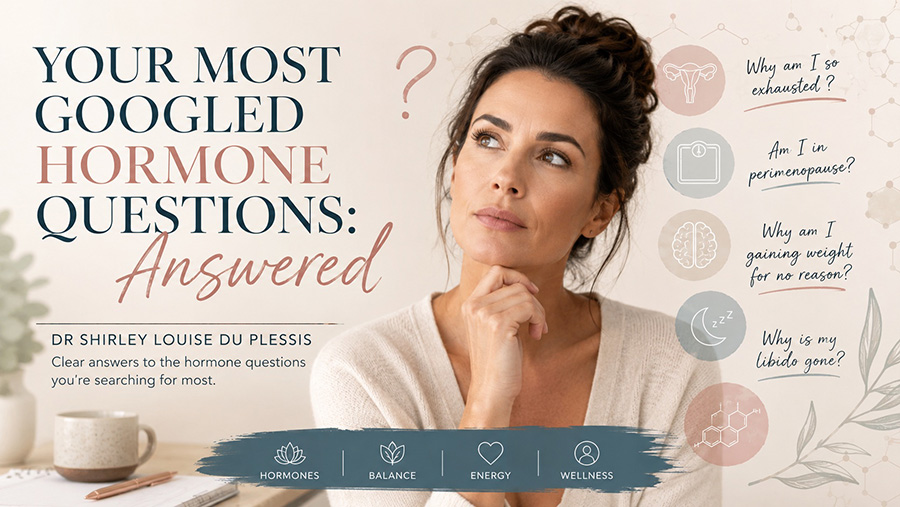
We’ve all done it. Typed a symptom into Google late at night and hoped for reassurance by the second paragraph. Hormones are often blamed for everything from exhaustion and weight gain to mood changes and low libido, but the reality is usually far more nuanced. In this article, Dr Louise du Plessis explores some of the most commonly searched hormone questions, offering a more grounded and holistic perspective on what these symptoms may actually mean.
1) Do I have a hormone imbalance?
The short answer? Maybe. But it’s rarely as simple as a yes-or-no question.
Hormones don’t operate in isolation. The body is a web of complex, interconnected systems that should never be viewed separately. Your hormones, gut, nervous system, thyroid, immune system, and every other system in your body are in constant communication, each influencing the other and all responding to the choices you make daily.
Take something like heart palpitations. It might be an adrenaline surge during a stressful moment… or it could just as easily be an immune response to the pizza you had for lunch that didn’t quite agree with you. Same symptom, very different root causes.
So when something feels “off,” it’s rarely just one hormone misbehaving. It’s usually part of a much bigger conversation happening within the body.
In other words: yes, your hormones might be part of the problem. But they might also be a casualty of another system that is struggling to regulate.
2) Why am I gaining weight for no reason?
Weight gain is by far one of the most common complaints seen in practice. “Nothing in my life has changed, but my body clearly has.”
But here’s the uncomfortable truth: something doesn’t come from nothing. So where are these extra kilos sneaking in?
While lifestyle absolutely plays a role, weight gain is rarely just about willpower or calories. Insulin resistance, for example, can shift your body into storage mode, while thyroid function can influence how efficiently you burn energy. These are not things you can out-discipline. They require proper understanding and, often, proper investigation.
And then there’s the biggest culprit of modern life: cortisol.
When you’re in a constant state of stress, your body behaves as if it’s preparing to run away from a lion. Cortisol mobilises energy by breaking down muscle and releasing glucose into the bloodstream, ensuring your muscles have immediate access to fuel. Helpful, if you’re actually running.
But in reality? There is no lion. There are just emails and a never-ending to-do list. And no one is sprinting through traffic at 4 pm. So that excess glucose has nowhere to go, and cortisol neatly stores it away for later.
Chronic stress, under-eating, overtraining, poor sleep, and yes, even hormonal imbalances, can all trigger this same stress response.
So no, training harder and eating less won’t always fix the problem. In some cases, it may even make it worse.
3) Why am I exhausted all the time?
While it’s tempting to jump on the social media bandwagon and call everything “adrenal fatigue,” the reality is a little more complex, and a lot more helpful.
Persistent fatigue is often a result of:
- Blood sugar highs and crashes
- Poor sleep quality (not just quantity)
- Nutrient deficiencies
But again, one of the most common culprits is dysregulated cortisol.
That wired-but-tired feeling? That’s usually your nervous system stuck in overdrive. And you need a whole-system approach to help the body regulate again.
4) Is it okay to use the pill long-term?
This one deserves a balanced, non-dramatic answer.
For many women, the pill is a useful tool. It can regulate cycles, reduce pain, and is still a very effective and convenient option for contraception.
But it’s important to understand what it’s doing.
The pill doesn’t “balance” hormones. It suppresses your natural cycle and replaces it with a controlled hormonal environment. That can be helpful symptomatically, but it doesn’t address underlying drivers like PCOS, insulin resistance, or inflammation.
Long-term use is not inherently harmful for everyone, but it may:
- Mask underlying issues
- Impact nutrient levels (e.g. B vitamins, zinc)
- Alter libido or mood in some individuals
The key question isn’t “Is the pill good or bad?”
It’s “Is this the right tool for me, right now?”
5) Am I in perimenopause?
Perimenopause has entered the chat, and Google knows it.
This transitional phase can start as early as your mid-30s to early 40s, long before your periods stop. And it is by no means a gentle stroll in the park. It’s more like a rollercoaster. Off a very high cliff. Into a dungeon. With dragons.
If you’re one of the less dramatic women, you might notice more subtle changes: slightly irregular cycles, a bit more irritability, some brain fog, and the occasional sleep disturbance.
Or… you might be the out-of-the-box version, dealing with things like itchy ears, sudden anxiety, or a mysterious new intolerance to coffee or alcohol, a true sign that God has a sense of humour.
Your hormones are not simply declining at a slow and steady rate. Oestrogen, in particular, can swing quite dramatically. So if one day you feel perfectly fine, and the next you’re crying at a dog food advert… yes, it might be worth taking a closer look at your hormones.
6) Why do I have zero libido?
When it comes to libido, you might feel like a solo act, but hormonally and biochemically, it’s more like an orchestra.
Yes, hormones like oestrogen, progesterone, and testosterone are major players, but so are your brain, your emotions, and, let’s not forget, the physical body itself. And of course, you can’t have lights, camera, action without the right stage and lighting.
Before diving into complex hormone testing, it’s worth ruling out the most common mood-killers: poor sleep, relationship dynamics, body image concerns, and, once again, stress. If your body doesn’t feel safe, it will always prioritise survival over reproduction.
Many people also underestimate the impact of medications. The contraceptive pill and SSRIs, in particular, are well-known for dampening libido in some individuals.
And then there’s brain chemistry. Dopamine drives desire and motivation, while serotonin keeps things calm, but too much of it can blunt that spark.

The Bottom Line
Your hormones are not random, and they are not keeping you hostage.
And unfortunately, the algorithms have yet to decipher the quick hacks for the very real stressors, shifts, and signals happening inside the body.
So before you fall down the rabbit hole of endless supplements and influencer opinions, rather find a committed healthcare practitioner who will help you listen to what your body is trying to tell you.
About the author

Dr Louise du Plessis completed her MBChB at the University of the Free State in 2018. After completing her government service, she began working as a general practitioner in a small town, where she developed a deeper interest in a more holistic approach to healthcare.
Believing that true health is not merely the absence of disease but the pursuit of vitality and balance, Dr du Plessis pursued training in Functional and Integrative Medicine. Her main areas of interest include root cause investigations and preventative medicine—whether hormonal, metabolic, or across other health systems. She is committed to asking how each patient can become the best version of themselves and supporting them in sustaining that wellness for as long as possible.
Driven by her faith and a genuine love for people, she embraces a patient-centred approach that considers the whole person—body, mind, and lifestyle. Outside of her medical practice, Dr du Plessis enjoys spending quality time with her family, listening to music, travelling, and exploring nature through hiking